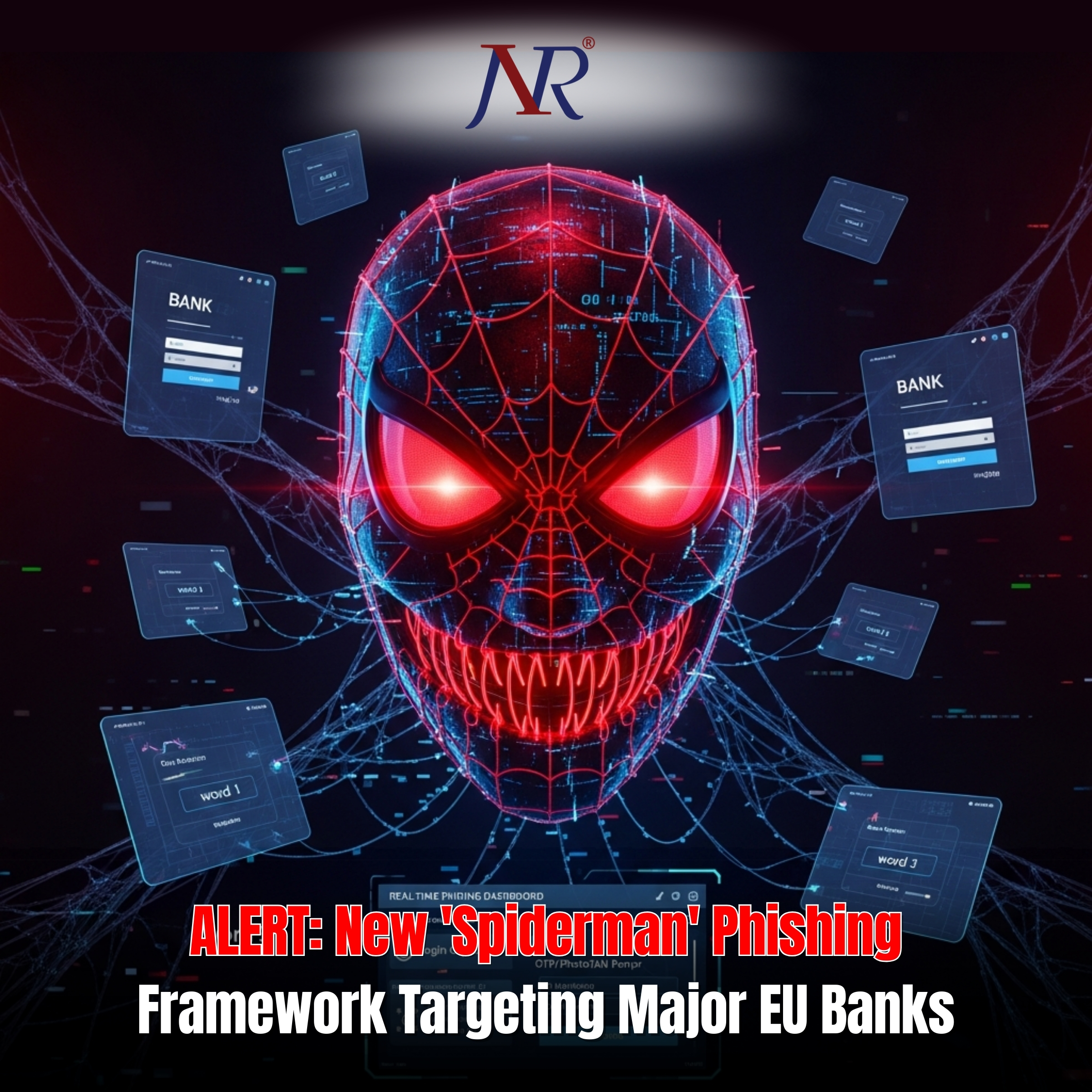
Cybersecurity researchers at Varonis have identified Spiderman, a sophisticated full-stack phishing framework circulating on dark web marketplaces and private Signal groups that enables attackers with minimal technical expertise to launch coordinated credential theft campaigns against dozens of major European banks and cryptocurrency platforms. The kit's professional architecture, real-time session management, and advanced anti-detection mechanisms represent a significant escalation in phishing infrastructure maturity, reducing barriers to entry for financially motivated cybercriminals across five European countries.
Spiderman represents a qualitative shift in phishing-as-a-service offerings. Unlike single-bank phishing kits that have proliferated for years, Spiderman consolidates dozens of major European financial institutions into a unified, modular control panel. This consolidation enables attackers to rapidly pivot between targets, launch campaigns across borders, and manage multiple attack vectors through a single interface.
The kit's target scope spans major financial institutions across Germany, Austria, Switzerland, Belgium, and Spain, including Deutsche Bank, Commerzbank, ING (both German and Belgian operations), and CaixaBank. Beyond traditional banking, the framework includes dedicated modules for cryptocurrency wallet theft, supporting Ledger, Metamask, and Exodus—indicating a strategic shift toward hybrid financial fraud combining traditional banking credentials with cryptocurrency seed phrase harvesting.
Distribution through private Signal messenger groups suggests an organized, closed community of approximately 750 active members—a sizable user base indicating Spiderman is not a prototype but a mature, actively deployed framework already generating significant fraudulent revenue.
Spiderman's primary strength lies in operational simplicity. Attackers select a target institution from a dropdown menu, click "Index This Bank," and the system automatically generates a pixel-perfect clone of the legitimate banking login portal. The generated phishing page includes login fields, password prompts, two-factor authentication screens, credit card entry forms, and personal information fields—all mimicking the authentic institution's branding, layout, and user experience.
Victims directed to these phishing sites encounter no visual indicators distinguishing them from legitimate banking platforms. The psychological impact of institutional branding combined with expected authentication workflows significantly increases credential submission rates compared to generic phishing attacks. Users anticipate legitimate security prompts and undergo authentication sequences, unknowingly surrendering sensitive authentication tokens to attackers.
The operator control panel displays victim sessions in real time, tracking each target's inputs, device characteristics, and session status. Once a victim submits initial login credentials, the operator receives immediate notification and can dynamically trigger additional prompts requesting:
Credit card details (full card number, expiration date, CVV)
Personal identification information (full name, date of birth, phone number)
Two-factor authentication codes (OTP, PhotoTAN codes)
Transaction authorization numbers (TANs)
This interactive exploitation workflow converts each phishing session into an intelligence-gathering operation. A single victim session can yield a complete identity packet sufficient for comprehensive account takeover, SIM swapping attacks, credit card fraud, and downstream identity theft operations.
The unique session identifier system enables attackers to maintain continuity through multi-step phishing workflows, marking sessions as "Finished" only after extracting maximum intelligence from compromised users.
Particularly concerning is Spiderman's real-time One-Time Password (OTP) and PhotoTAN capture capabilities. Many European banks rely on PhotoTAN applications or SMS-based transaction authentication numbers for transaction authorization. Spiderman's infrastructure enables attackers to intercept these time-sensitive codes as users enter them, effectively neutralizing two-factor authentication mechanisms that have traditionally protected financial accounts.
This capability represents a significant threat escalation. Even banks implementing multi-factor authentication remain vulnerable because the attacker operates within the compromised user session, capturing authentication tokens in real time before they expire. Traditional security architectures assuming OTP codes cannot be simultaneously intercepted and used by attackers prove inadequate against this attack pattern.
Spiderman's technical sophistication extends beyond credential capture to include robust anti-analysis capabilities designed to evade security researchers, automated scanners, and threat intelligence platforms:
Country Whitelisting: Access restricted to specific geographic regions (Germany, Austria, Switzerland, Belgium, Spain), preventing out-of-region security researchers from analyzing the phishing infrastructure.
ISP and ASN Filtering: Blocks traffic from known data centers, cloud infrastructure providers, VPN services, and security firm networks, preventing automated security scanning and manual analysis.
Device-Type Filtering: Serves phishing pages only to specific device types (desktop, mobile, Android, iOS), restricting visibility to security tools operating from different environments.
Custom Redirect Controls: Sends non-target visitors to benign sites like Google, eliminating exposure to inadvertent security researcher analysis while maintaining plausible deniability.
These anti-detection mechanisms significantly reduce visibility to cybersecurity organizations, making the framework harder to identify, analyze, and disrupt than traditional phishing infrastructure.
Spiderman's inclusion of dedicated cryptocurrency modules ("Ledger Seedphrase," "Metamask Seedphrase," "Exodus Seedphrase") signals a strategic evolution in financial fraud operations. Rather than separating banking and cryptocurrency theft, Spiderman enables operators to harvest both banking credentials and cryptocurrency seed phrases through unified infrastructure. This hybrid approach maximizes victim value—a single compromised user can yield both financial account access and cryptocurrency holdings.
The cryptocurrency component also provides operational advantages for criminals. Unlike banking fraud, which generates forensic trails and regulatory reporting, cryptocurrency theft enables direct fund transfers to attacker wallets with minimal reversibility.
Varonis researchers assess Spiderman as "one of the most dangerous phishing kits analyzed this year" based on several factors:
Cross-Border Consolidation: Most phishing kits target single institutions or regions. Spiderman's multi-country, multi-institution approach enables efficient attack scaling without infrastructure rebuilding.
Lowered Skill Barriers: The elimination of web development requirements democratizes phishing attacks, enabling technically unsophisticated cybercriminals to execute sophisticated campaigns.
Modular Architecture: The system's modular design accommodates new banks, authentication methods, and financial services as European e-banking infrastructure evolves.
Active Community Support: The 750-member Signal group provides ongoing tool refinement, technique sharing, and intelligence regarding emerging banking security measures.
European financial institutions and customers face immediate elevated risk requiring multi-layered defensive responses:
Enhanced Authentication Monitoring: Banks must implement behavioral analysis detecting anomalous login patterns, device fingerprinting, and geographic impossibilities suggesting account compromise.
Customer Education: Financial institutions must conduct aggressive phishing awareness campaigns emphasizing that legitimate banks never request OTP codes or complete credential sets through independent communications.
Anomalous Transaction Detection: Implement real-time transaction analysis detecting unauthorized access patterns, unusual beneficiary transfers, or cryptocurrency exchange activity inconsistent with customer history.
Regulatory Coordination: European regulators must coordinate rapid phishing site takedown and ISP filtering to disrupt the attack infrastructure underlying Spiderman campaigns.
The Spiderman kit represents the maturation of phishing-as-a-service into a professional fraud infrastructure requiring urgent defensive evolution from European financial institutions and regulators. As European e-banking standards continue evolving, Spiderman's modular architecture will likely adapt in parallel, maintaining threat relevance across regulatory updates and security mechanism changes.