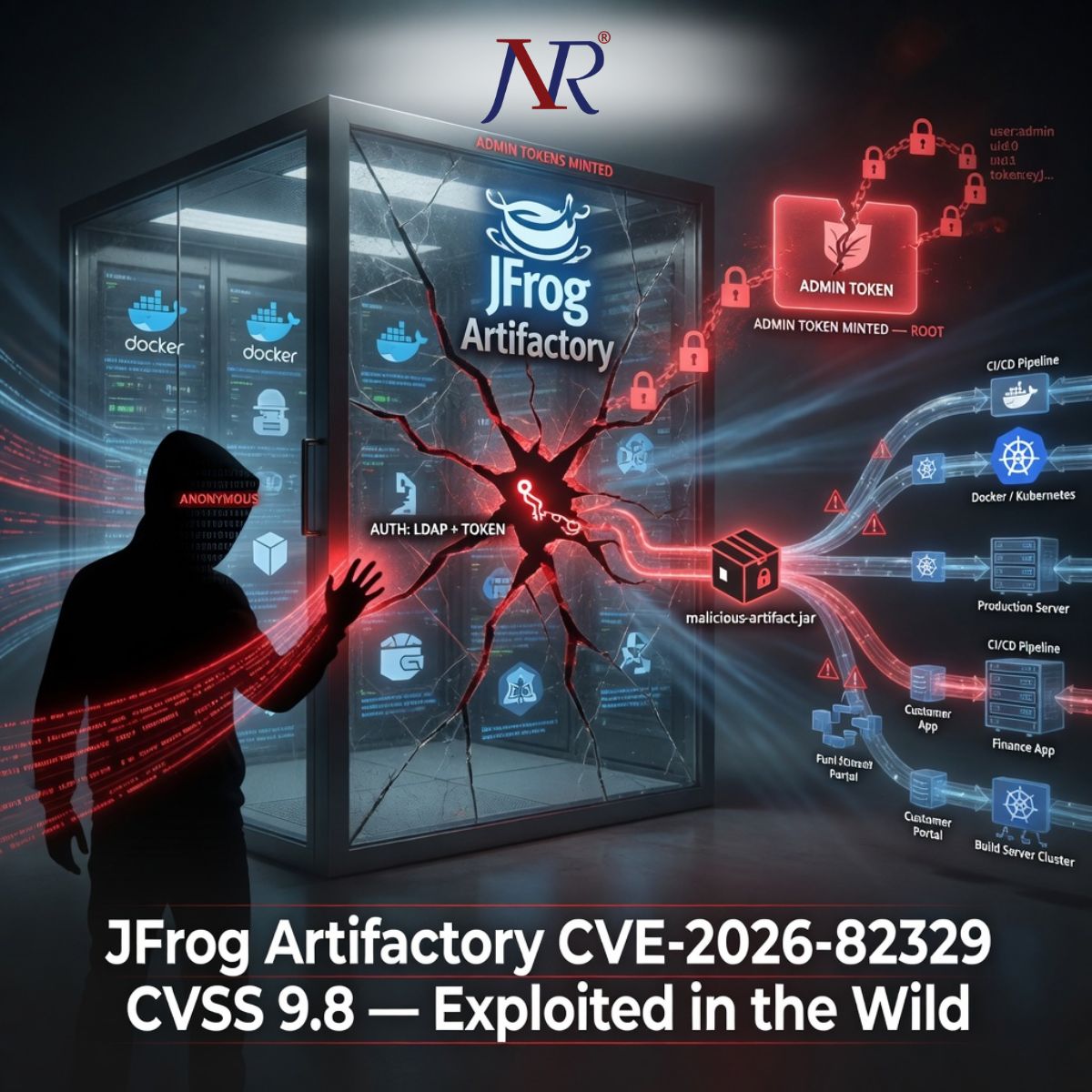
A critical authentication bypass vulnerability in JFrog Artifactory — the artifact repository management platform used by 83% of the Fortune 100 — is being actively exploited in the wild less than 96 hours after its public disclosure, according to threat intelligence from WatchTowr Labs. The vulnerability, tracked as CVE-2026-82329 and carrying a CVSS score of 9.8, allows an unauthenticated attacker with network access to obtain full administrative privileges under Artifactory's default configuration. JFrog patched the flaw on August 28, 2026, but self-hosted instances that have not yet been updated remain fully exposed. WatchTowr principal threat intelligence specialist Yordan Ganchev confirmed exploitation beginning September 1, just four days after disclosure — describing the speed as moving from disclosure to real-world exploitation with uncomfortable efficiency.
CVE-2026-82329 resides in JFrog Access, the component responsible for issuing and validating credentials within Artifactory. Instances without an additional join key configured receive what WatchTowr describes as a phantom join key — a predictable credential that attackers can abuse to forge access and mint administrator-level tokens without any authentication, user interaction, or elevated starting privileges. The CVSS vector confirms the worst-case scenario: network-accessible, low complexity, no privileges required, no user interaction, and high impact on confidentiality, integrity, and availability. Vercel CEO Guillermo Rauch described it on LinkedIn as an RCE bomb, noting that because Artifactory hosts binaries, administrative access allows poisoning of the entire software distribution chain, with damage extending far beyond credential theft.
WatchTowr's global AttackCapture honeypot network has observed attackers using the flaw to mint administrator tokens, enumerate users and groups, extract credential sets, and map federated access topologies — in some cases creating backdoor administrator accounts that would survive remediation if not specifically identified and removed. Ganchev noted that some observed activity indicated CVE verification only — exploitation confirmed, then stopped — while other attempts moved to active enumeration of the Artifactory environment to assess whether the instance merited further attack. A small number of attacker IP addresses from varying geographies have been identified. Broad mass exploitation has not yet been observed, but the technical simplicity and high-value nature of Artifactory means that window is likely to close quickly.
JFrog Artifactory is not a peripheral IT tool — it is the foundational infrastructure of modern software delivery. Ganchev framed the core risk precisely: when attackers gain admin-level access to a central software supply chain system, they can do what every engineering team does best — build, ship, and distribute software fast. From that position, attackers can tamper with build pipelines, inject malicious code into binaries and container images, poison artifact caches, exfiltrate proprietary code and credentials, move laterally into production systems, and push malicious changes downstream to every customer and system that trusts the repository as a source of truth. As iCounter CEO John Watters noted, an attacker who can mint admin tokens is not just gaining access to a system — they are gaining the ability to touch every build, package, and container image the organisation ships downstream.
All organisations running self-hosted JFrog Artifactory must update to patched versions immediately: 7.111.21, 7.117.28, 7.125.20, 7.133.29, 7.146.38, or 7.161.20. Cloud-hosted instances have already been patched by JFrog. After patching, security teams must audit all Artifactory audit logs for unauthorised admin token creation, revoke and reissue every administrator token across all self-hosted instances, remove any unexplained backdoor users or accounts, review all connected systems for malicious changes, rotate all credentials stored within the repository, and confirm the exact installed version against the affected version list rather than relying on update date alone.