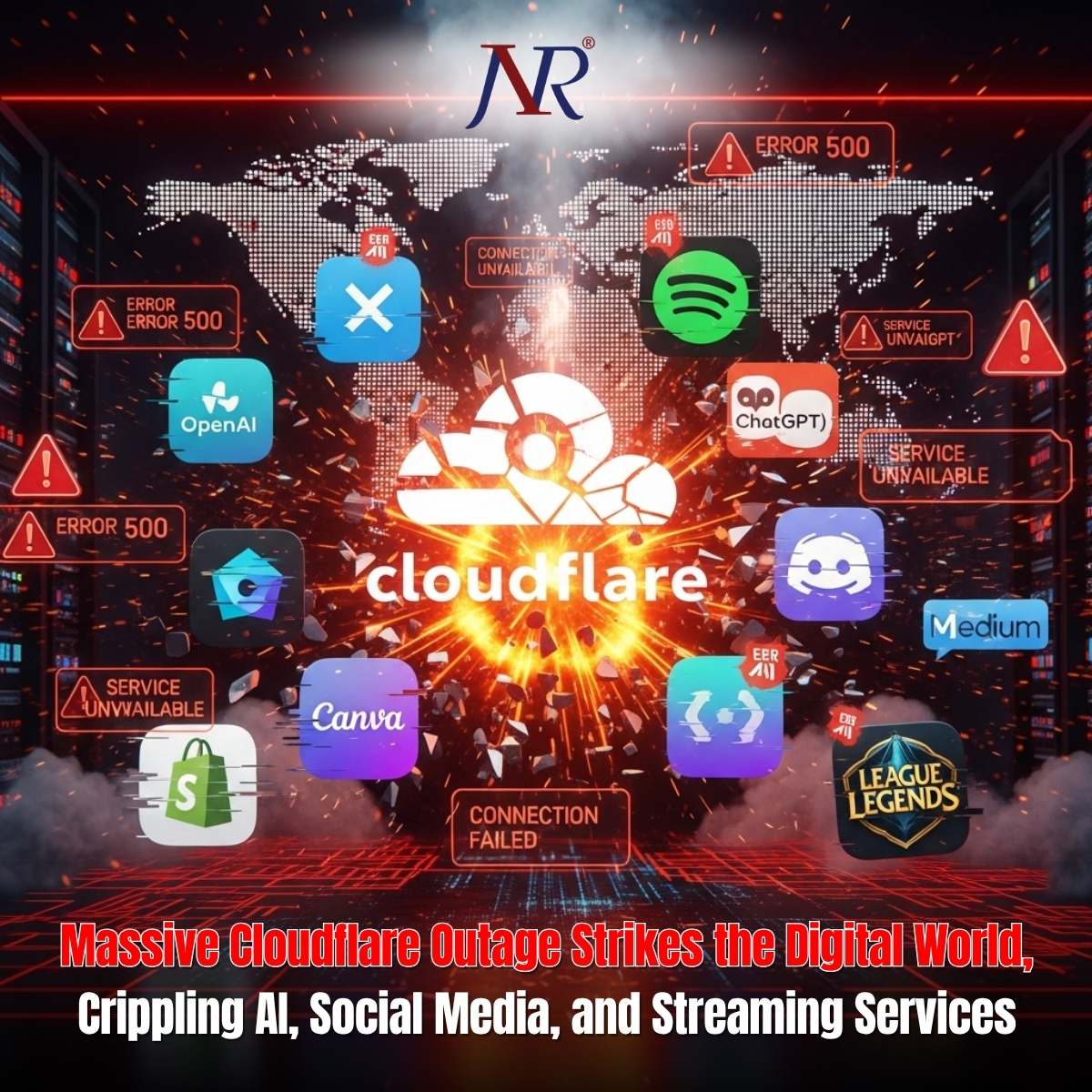
A critical infrastructure failure at Cloudflare, the internet's most invisible but essential gatekeeper, triggered a cascading outage affecting millions of users worldwide on November 18, 2025. The incident exposed the fragility of centralized internet infrastructure, demonstrating how a single configuration file malfunction could paralyze thousands of websites and services simultaneously—from social media giant X to artificial intelligence platforms, music streaming services, gaming networks, and e-commerce platforms.
Cloudflare first acknowledged the problem at 11:48 UTC, initially describing it as an "internal service degradation" affecting multiple core services including Access and WARP, the company's zero-trust network security solution. Within minutes, error messages began flooding across the internet as millions of users encountered Cloudflare's internal server errors while attempting to access dependent websites and services.
The irony proved particularly acute: Cloudflare's own status page became inaccessible during the crisis, preventing real-time communication with affected customers and leaving service operators blind to remediation progress. This information blackout compounded user frustration during hours of uncertainty.
The outage's scope quickly became apparent as high-profile platforms dependent on Cloudflare's content delivery network, DDoS protection, and DNS services suffered catastrophic failures:
Social Media: X (formerly Twitter) experienced patchy availability with users reporting persistent loading failures and connection errors, generating over 11,000 outage reports at peak disruption, with 61% affecting the mobile app and 28% the website.
Artificial Intelligence: OpenAI's ChatGPT and Perplexity AI became inaccessible for millions, displaying Cloudflare error pages instead of AI responses—a particularly frustrating experience for users accustomed to reliable service.
Entertainment and Commerce: Spotify, Discord, League of Legends, Canva, Shopify, Medium, and Letterboxd all experienced unavailability, affecting millions of users attempting to access entertainment, commerce, and creative services.
Transparency Irony: Downdetector itself, the outage tracking platform relied upon to report service disruptions, also went offline—a meta-commentary on infrastructure interdependencies.
Cryptocurrency exchanges dependent on Cloudflare's infrastructure also experienced disruptions, with users unable to access trading platforms during periods of market volatility.
By 13:04 UTC, Cloudflare engineers identified the root cause: a configuration file automatically generated to manage threat traffic had grown beyond its expected size, triggering a crash in the software system handling traffic for multiple Cloudflare services.
This seemingly minor technical issue—a file exceeding size thresholds—cascaded through interconnected systems with devastating consequences. Cloudflare explicitly stated there was no evidence of attack or malicious activity, eliminating security compromise as a factor.
The incident occurred during scheduled maintenance across multiple global datacenters (Los Angeles, Atlanta, Santiago, and Tahiti), potentially complicating operational response as traffic rerouting procedures created additional latency. WARP access in London was temporarily disabled as an emergency containment measure.
By 13:13 UTC, approximately 90 minutes after initial reports, Cloudflare had implemented fixes allowing Access and WARP services to recover with error rates returning to normal. However, the company cautioned that other services would experience "brief degradation as traffic naturally spikes post-incident" and required additional hours for complete recovery.
The company's support portal also experienced disruptions stemming from third-party provider issues, though alternative support channels (live chat and emergency telephone lines for Enterprise customers) remained operational.
Professor Alan Woodward from Surrey Centre for Cyber Security characterized Cloudflare as "the biggest company you've never heard of"—a description capturing the company's invisibility combined with its irreplaceable role in internet infrastructure. Cloudflare's services include defending millions of websites against distributed denial-of-service attacks, managing threat traffic, verifying user authenticity, and accelerating performance across websites, APIs, and AI workloads.
Woodward's observation proved prescient: when infrastructure gatekeepers fail, the entire internet visibly falters. The November 18 incident follows AWS's US-EAST-1 outage last month (which lasted over 15 hours and affected Slack, Atlassian, and Snapchat) and Microsoft Azure's global outage in October caused by inadvertent DNS configuration changes.
These cascading failures within weeks of each other underscore a critical infrastructure vulnerability: the internet depends on a handful of centralized providers operating complex systems under extreme operational pressures.
The incident highlights the absence of adequate redundancy and failover mechanisms across internet infrastructure. When Cloudflare fails—regardless of cause—millions of services become inaccessible simultaneously, affecting billions of people globally. This centralization represents a systemic risk comparable to traditional critical infrastructure vulnerabilities.
Cloudflare acknowledged responsibility, apologizing "to the internet in general for letting you down today" and committing to learning from the incident. However, technical statements about improved monitoring provide limited reassurance regarding fundamental architectural fragility.
The November 18 outage served as a sobering reminder that the internet's apparent robustness masks critical dependencies on an extraordinarily narrow infrastructure base. As digital transformation accelerates globally, this concentration risk demands urgent attention from regulators, technologists, and policymakers.